

Ensuring the safety of students during transportation is one of the biggest priorities for any school. Today, schools are upgrading from manual monitoring to the Best School Bus Tracking System — a technology that brings real-time visibility, safety alerts, and complete peace of mind for parents and school admins.
What is a School Bus Tracking System?
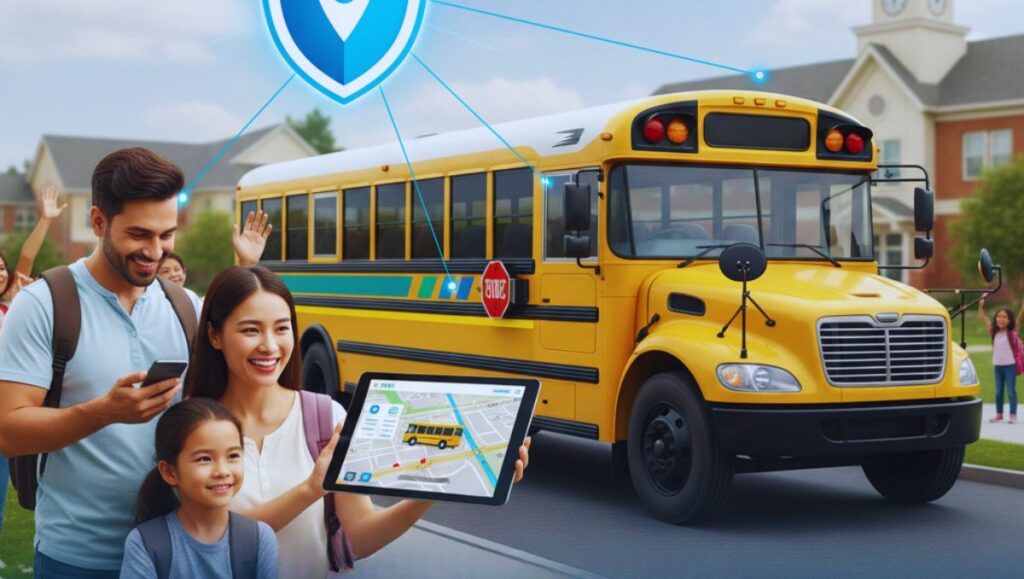
A School Bus Tracking System is an intelligent technology tool that makes school transportation safer, visible, and efficient. It applies GPS location, mobile applications, RFID, CCTV cameras, and real-time notifications such that the schools and parents can view the precise location of the buses and students at any given time.
This system is used by:
- Schools
- Transportation managers
- Parents
- Fleet operators
How a School Bus Tracking System Works
1. GPS Device Installed in the Bus
Every bus has a little GPS tracker.
It constantly updates:
- Live location
- Speed
- Route
- Driver behaviour
These updates are sent to a central platform and the parents’ app.
2. Mobile App for Parents
Parents get a mobile app where they can:
- Track the bus in real time
- See the estimated arrival time (ETA)
- Receive notifications when the bus reaches pickup or drop-off points
- Get safety alerts during emergencies
This reduces waiting time and gives peace of mind.
3. Dashboard for School Management
A dashboard displayed to the school staff will reveal:
- All bus locations
- Route deviations
- Speeding alerts
- Driver performance
- Attendance reports
This allows schools to operate transport operations flawlessly.
4. Student Attendance Tracking (RFID / QR / Face-Recognition)
Students swipe with an RFID card, QR, or biometric scan.
When they board or leave the bus:
- The attendance is automatically taken.
- The parents receive confirmation alerts.
This eradicates human error and enhances security.
5. CCTV / Live Camera Monitoring
CCTV cameras are used to assist schools in monitoring many systems:
- Driver behavior
- Student safety
- Any unexpected incidents
CCTV has also recorded evidence where necessary.
6. Emergency SOS & Safety Features
The system includes:
- SOS panic button
- Automatic notices when there is a breakdown or accident.
- Real-time informing of the parents and school administrators.
This goes hand in hand with rapid response in case of an emergency.
Why Schools Use a School Bus Tracking System
✔ To ensure student safety
It eliminates traffic accidents, time loss, and driving misconduct.
✔ To gain complete visibility
Nobody is ever uncertain about the bus position and whereabouts.
✔ To improve communication
No further calls to the staff or drivers are needed to update.
✔ To reduce operational costs
Optimized routes save fuel and time.
✔ To build trust with parents
Transparency and confidence are increased due to real-time tracking.
Key Components of a School Bus Tracking System
- GPS Tracking Device
- Parent Mobile Application
- School Admin Dashboard
- RFID/QR/Biometric Attendance
- CCTV Cameras (optional but highly useful)
- Geo-fencing Alerts
- Speed & Driver Behavior Monitoring
- Emergency Panic Button
Core Features of the Best School Bus Tracking System
Real-Time GPS Tracking & Live Bus Location
- Each bus has a GPS device that broadcasts its position at any given moment to a central platform or mobile application.
- At any given time, parents and administrators can see the bus on a map and receive an ETA for the pickup or drop-off.
- This minimizes uncertainty, long queues, and anxiety, particularly among parents.
Why it matters: Provides sanity and clarity. Parents are aware of the location of the bus that is carrying their child; schools are aware of the bus being on the right track.
Automated Student Boarding / Drop-off Attendance (RFID / Biometric / QR / Smart-card Integration)
- Upon entering or exiting, a student using an RFID card (or smart card), a student taps the card (or biometric / QR). The attendance is automatically logged into the system.
- The system knows precisely who boarded or got off and when—no child is lost.
- Parents receive real-time notifications either through the app or SMS when their child boards or leaves.
Why it matters: Eliminates manual attendance errors, improves safety, and gives parents assurance about their child’s movement.
Route Management & Optimization
- Bus routes and stops can be defined by the schools and can be changed by the administrators.
- Some systems have GPS information; some of them provide route optimization, which allows buses to take the optimal route, reducing fuel and travel time as well as the total cost.
- Higher systems permit dynamic re-routing in case of a traffic jam or any other disruption.
Why it matters: Saves time and money for schools, ensures timely pick-ups/drop-offs, and improves the efficiency of the entire transport operation.
Alerts & Notifications (Pick-up/Drop-off, Route Deviation, Overspeed, Emergency, etc.)
- When the bus comes to the parents’ pickup point, when the child gets into the bus or out of the bus, and when the bus is close, these notifications are sent to parents.
- In case the bus is not following the scheduled path (geo-fencing) or has unauthorized stops, the school administrators and parents are alerted.
- Overspeed or dangerous driving detectors track the actions of the driver and notify the police in case the safety standards are not followed.
- The emergency/SOS button sends emergency alerts in the case of an accident, breakdown, or any other emergency; an immediate alert is sent to the relevant people.
Why it matters: Enhances safety, ensures accountability, improves responsiveness to emergencies—and gives confidence to parents and school authorities.
Centralized Dashboard & Multi-stakeholder Apps (Admin, Parent, Driver)
- School administrators receive an all-encompassing dashboard with all buses, their positions, routes, trip history, attendance, alerts, and general transport information.
- Parents also have a special mobile application to track the bus location, alerts/notifications, ETA, and also be sure when their child gets on the bus and when they get out.
- Some systems provide a driver with an application or a computer on the dashboard displaying upcoming destinations, student names, seating, and route directions.
Why it matters: Gives transparency to all the stakeholders- parents, school, and drivers. Facilitates management and communication, and eliminates or minimizes manual phone calls or confusion.
Trip History, Reporting & Analytics
- All bus movements, routes, schedules, attendance of students, and notices are recorded and stored- allowing one to view the playback of the movements, route history, and review the incidents.
- Schools are able to produce reports, e.g, on punctuality, driver behaviour, usage patterns, compliance, student boardings, which are useful during audit, safety compliance, and transport optimization.
- It can be used in long-term planning, tracking the efficiency of transport, and being accountable.
Why it matters: Guarantees transparency, helps in decision-making, and acts as evidence in case of disputes or incidents.
Safety & Compliance Features (Geo-Fencing, CCTV / Camera Integration, Regulatory Compliance)
- Geo-Fencing: The system can define virtual boundaries (for bus routes, school zones, neighborhoods). If a bus leaves the allowed zone, the system alerts administrators. (traceschoolbus.com)
- CCTV / In-bus cameras + live / recorded video: Most new-fangled tracking systems already have camera surveillance systems within the bus to monitor driver conduct and student security.
- Compliance with regulations: A good system has to comply with the laws in those areas where government regulations demand GPS surveillance, speed management, and other safety regulations (e.g, some Indian states).
Why it matters: Provides more than a school bus tracking system, it ensures the security of students, eliminates abuse, and makes the transport system both legally appropriate and audit-ready.
Benefits of Using the Best School Bus Tracking System
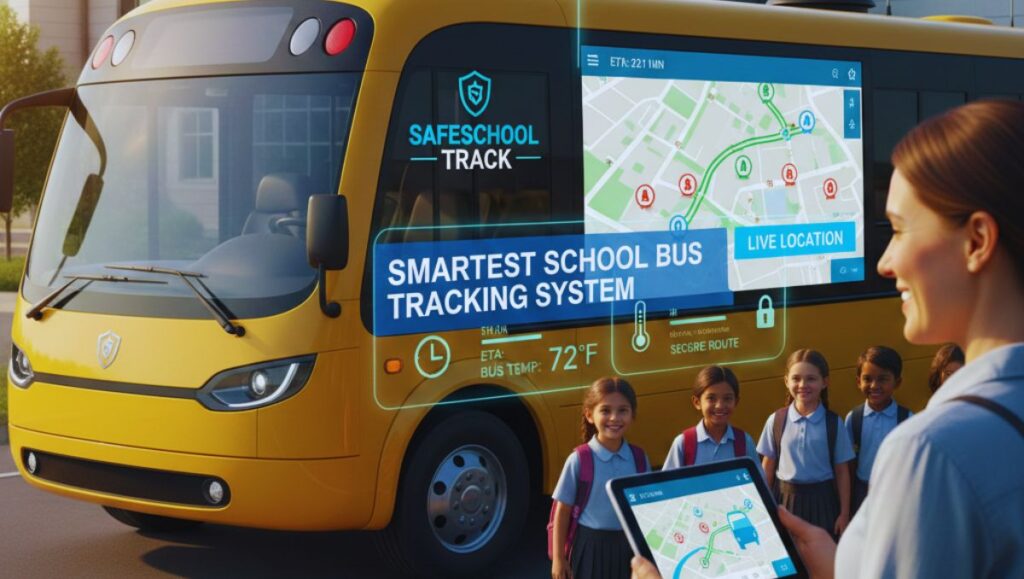
A school bus tracking system is not a GPS tool; it is an ultimately safe, totally managed tool that revolutionizes the way schools deal with transporting students. The benefits are potent and enduring, ranging from real-time location visibility to automated attendance and emergency support.
1. Maximum Student Safety
The first reason why schools implement a school bus tracking system is safety.
How it improves safety:
- Schools are able to know the location of all the buses in real time.
- The parents are even aware of the time of boarding, travelling, as well as dropping off the child.
- Overspeeding, rough braking, or reckless driving is immediately identified.
- Panic (SOS) buttons enable instant reaction during an emergency.
Result:
Children travel under constant digital surveillance, reducing risks and giving parents complete reassurance.
2. Peace of Mind for Parents
Parents are also usually concerned with delays, safety accidents, or whether the child got into the bus.
With a tracking system:
- They can get updated on the position of the buses in real time.
- Automatically receive notifications when the child enters and leaves the bus.
- Have the estimated arrival time (ETA) so that they do not have to wait outside.
- Can track the bus route from anywhere.
Result:
Parents feel in control and connected to their child’s journey every day.
3. Improved Operational Efficiency for Schools
Using manual management of a number of buses is hectic and time-consuming.
A tracking system can assist schools:
- Control all the buses in a single dashboard.
- Buses should follow the right routes.
- Determine delays or route delays immediately.
- Minimize the unproductive communication with drivers.
Result:
Transport operations become organized, transparent, and easy to manage.
4. Reduced Fuel & Maintenance Costs
Driving inefficiency and bad route planning raise the fuel consumption.
The system:
- Helping schools are the planners of the shortest and safest routes.
- Stalling of the track, rough braking, and speeding.
- Reduces unauthorized trips
- Saves on fuel wastage as well as unnecessary wear and tear.
Result:
Schools save money every month while keeping the fleet healthy.
5. Automated Attendance System
The manual monitoring of the bus attendance of students is time-consuming and prone to errors.
With RFID/QR/Biometric integration:
- The attendance is automatically marked.
- Parents receive immediate de-boarding and boarding notifications.
- Schools are able to obtain correct trip attendance reports.
Result:
Zero manual errors + complete transparency + time saved for teachers/drivers.
6. Faster Emergency Response
The system assists in case of an emergency, breakdown, accident, or health problem.
Features like:
- SOS button
- Real-time bus monitoring
- Driver communication
- Instant alerts to the school
allow quick action without confusion.
Result:
Schools respond faster and ensure student protection during unexpected events.
7. Driver Accountability and Better Behavior
The drivers are aware that they are under surveillance, which, of course, enhances discipline.
The system tracks:
- Speeding
- Harsh acceleration
- Sudden braking
- Route deviation
- Unscheduled stops
Result:
Safe and responsible driving habits reduce the chance of accidents.
8. Complete Transparency & Trust
School transport is a matter of concern with parents. This system removes doubts.
Transparency increases because:
- Each transport movement of the bus is monitored.
- Complete trip history is offered.
- Notifications and alerts keep all people informed.
Result:
Trust improves between the school, parents, and transport staff.
9. Better Communication (No More Calls!)
Traditional school transport requires constant calls:
- “Where is the bus?”
- “Why is it late?”
- “Did my child reach school?”
With real-time tracking:
- No need to call drivers
- Parents see all updates on the app
- Schools get automated reports
Result:
Zero communication gap, zero confusion.
10. Useful Reports & Analytics
The system generates detailed reports, such as:
- Trip history
- Driver behavior
- Student attendance
- Stop duration
- Fuel usage
- Maintenance alerts
Result:
Schools make smarter decisions, improve routes, and maintain safety standards.
11. Compliance With Safety Regulations
Many regions require GPS-based tracking and speed monitoring for school buses.
A modern system ensures:
- AIS-compliant tracking devices
- Digital records for audits
- Safety documentation for government rules
Result:
Schools stay compliant and avoid penalties.
12. Brand Reputation for the School
Parents prefer schools that prioritize safety.
With a smart school bus tracking system:
- The school appears modern and responsible
- Safety becomes a strong selling point
- Parents feel more confident enrolling their children
Result:
Improved reputation + higher parent satisfaction.
Why Your School Needs the Best School Bus Tracking System Today
One of the most sensitive tasks that a school deals with on a daily basis is school transportation. Parents are concerned with safety, schools require effective functioning, and the transport teams should be punctual and disciplined. However, the old ways of doing things, such as calling over manually, writing down attendance, and attending to guessing, are no longer sufficient in the dynamic, safety-conscious world today.
It is in this regard that a School Bus Tracking System will be necessary.
Below are the detailed reasons why every school needs a smart tracking system today:
1. Safety Standards Are Increasing Every Year
Parents and government authorities expect schools to follow strict safety protocols.
Without a School Bus Tracking System:
- Schools cannot monitor buses in real time
- Emergency responses are delayed
- Driver behavior remains unchecked
- Parents are left in the dark
With a School Bus Tracking System:
- Every bus movement is monitored
- Parents can track their child’s journey
- Safety incidents are identified immediately
- Transport teams can respond faster
Why it matters:
Student safety is not optional—it’s a responsibility. Technology ensures it is fulfilled effectively.
2. Parents Demand Complete Transparency
Parents in the present generation want real-time information rather than mere promises.
They want to know:
- Where the bus is
- If the child boarded the bus
- When will it reach home
- Whether the driver is driving safely
All this is available on a mobile application through a tracking system.
This transparency builds trust, reduces complaints, and strengthens parent–school relationships.
Why it matters:
Parents choose the School Bus Tracking System that offers safety + transparency. It improves the school’s reputation.
3. Manual Monitoring No Longer Works
Traditional school transport management depends on:
- Phone calls
- Paper logs
- Driver updates
- Human memory
This causes mistakes, misunderstandings, time wastage, and miscommunication.
A school bus tracking system substitutes the entire guesswork with:
- Automated attendance
- Accurate real-time location
- Instant alerts
- Digital route management
Why it matters:
Automation eliminates human mistakes and enhances efficiency by a significant margin.
4. Traffic Conditions Are Unpredictable
Cities today face:
- Heavy morning traffic
- Construction work
- Roadblocks
- Sudden delays
With a live tracking system:
- Schools can monitor delays
- Parents get updated ETAs
- Buses can be rerouted smartly
- Safety is maintained even in unpredictable conditions
Why it matters:
Efficient navigation is time-saving, stress-relieving, and ensures that students are safe in the daily transport.
5. Rising Need for Driver Accountability
A school bus tracking system monitors driver behavior, such as:
- Overspeeding
- Harsh braking
- Rash turns
- Long idling
- Unscheduled stops
This creates accountability and improves discipline.
Why it matters:
Safe driving reduces the chance of accidents and protects students.
6. Emergencies Need Quick Action
Breakdowns, health issues, or accidents can happen anytime.
With tracking:
- SOS alerts reach school authorities instantly
- Live location helps provide quick assistance
- Parents are informed immediately
- Every moment is monitored
Why it matters:
Every second counts during emergencies. Technology speeds up response time.
7. Helps Schools Save Money
Yes — a school bus tracking system saves money in the long run.
It reduces:
- Fuel wastage
- Extra kilometers
- Unauthorized driving
- Wear & tear
- Manual errors
- Operational costs
Optimized routes + disciplined driving = lower expenses.
Why it matters:
Cost savings can be used for better facilities and education.
8. Accurate Student Attendance on the Bus
Many schools struggle with:
- Wrong attendance
- Missing entries
- Manual errors
RFID/QR/Biometric systems ensure:
- Automatic boarding/deboarding updates
- Live attendance reports for parents
- No confusion or mistakes
Why it matters:
More accuracy = more safety.
9. Improves the School’s Brand Image
Parents would want to attend schools that are invested in safety technology.
A school bus tracking system shows that your school:
- Cares about safety
- Uses modern technology
- Ensures transparency
This becomes a strong selling point for admissions.
Why it matters:
Better reputation = more trust = more enrollments.
10. Future-Ready Transportation
Schools that adopt smart systems stay ahead of:
- Safety standards
- Parent expectations
- Technological advancements
School bus tracking system prepares your school for the future.
Why it matters:
It ensures long-term reliability and modernization.
How to Choose the Best School Bus Tracking System
You need to select a system that not only displays a moving dot on a map, but is actually resolving your school issues: safety, real-time communication, accurate attendance, and cost control. Examine the features, compliance, integration, support, cost, and privacy before you purchase.
1) Start with goals: define what “best” means for your school
List 3–5 concrete outcomes you need:
- Enhance the safety and emergency management of students.
- Eradicate bus attendance mistakes by hand.
- Reduce fuel and operational costs through route optimization
- Offer effective ETAs and boarding alerts to parents.
- Meet local transportation standards.
When your vendors are aware of what you want, they will offer you the features that actually count- not a fit-all-purpose package.
2) Must-have features checklist (shortlist these first)
Ensure the vendor supports these core features (with demonstrable performance):
- Real-time GPS tracking + accurate ETA (low latency & map provider).
- Student boarding/de-boarding attendance (RFID / QR / biometric) with automatic parent alerts.
- Driver behavior monitoring (overspeed, harsh braking, idle time) and alerting.
- Geo-fencing & route-deviation alerts (notify if bus leaves planned corridor).
- Parent mobile app & SMS fallback (push + SMS for low-smartphone parents).
- Admin dashboard with trip history & reports (downloadable reports for audits).
- CCTV / Video telematics option (live view/recording) — optional but increasingly important.
- Emergency SOS & remote diagnostics (device SOS button, wire-cut alerts).
When a product has none of these basics, then it is not the best but rather basic tracking.
3) Regulatory & hardware compliance (especially important in India)
Ensure that the device or solution is AIS-140 / ARAI / local VLT compliant (as required) and that it meets required features, including SOS, dual IP addresses, and centralized monitoring. Devices that do not meet standards can get you fined and expose safety loopholes.
4) Integration & interoperability
Ask whether the solution integrates with:
- Your school ERP / MIS (student roll data for automatic assignment)
- Existing CCTV or telematics vendors
- Payment/fee systems (if you want consolidated billing)
- Single Sign-On (SSO) for staff accounts
Good integrations reduce manual work and lower onboarding friction.
5) Data privacy, retention, and ownership
- Who owns the data (you must).
- How long is location/video/attendance data retained?
- Can you export raw data (CSV / API) for audits?
- Is data stored in-country (compliance with local data laws)?
Demand that a written provision of the contract should include data ownership and deletion policy.
6) Usability for every stakeholder
Test the parent app, admin dashboard, and driver interface (not just a sales demo):
- Is the parent app intuitive for non-technical users?
- Can admins create/modify routes easily?
- Does the driver device or app provide turn-by-turn guidance and stop lists?
An excellent UX minimizes call-ins and complaints from parents daily.
7) Performance, uptime & offline handling
Ask about:
- Uptime SLA and redundancy of the server.
- What happens when the bus goes out of cellular coverage — does the device cache and upload later?
- Location update frequency configurable (e.g., every 10 sec vs. 60 sec).
Real reliability beats flashy features every time.
8) Service, deployment & training
- Do they offer on-site installation or remote?
- Is there a pilot/poc (3–7 buses) before full roll-out? Run a pilot.
- What training is provided for drivers, conductors, and admin staff?
- Is there local support and spare parts availability?
Months of headaches will be spared with a vendor of fast local service.
9) Pricing model & TCO (total cost of ownership)
Compare apples-to-apples:
- Hardware cost (per device) + installation
- Monthly subscription per bus (SaaS) or per-user licensing
- Mobile SMS or data charges (some vendors bill separately)
- Implementation & integration fees
- Support / AMC / warranty costs
Calculate 3-year TCO and estimate savings from route optimization and fuel reduction to justify ROI.
10) Security, video storage & bandwidth
If you add in-bus CCTV, check:
- Where footage is stored (edge device vs cloud)
- Retention policy, encryption, and access controls
- Bandwidth requirements for live streaming (impact on mobile data cost)
Video is value added, and it is costly-balance need vs. budget.
11) Pilot checklist — what to test during a trial (3–7 buses, 2–4 weeks)
- Live location accuracy & ETA reliability.
- Boarding/deboarding attendance accuracy (RFID scans missed?).
- Alerts (overspeed, geo-fence breach) — are they timely and actionable?
- App usability for parents and admin workflows.
- Driver acceptance and real-world issues (mounting, wiring, power).
- Report generation and export.
The pilot should disclose common problems, in which case he should leave or insist on correction.
12) Implementation & change management tips
- Run a pilot with representative routes first.
- Train drivers and conductors — they are key to success.
- Communicate benefits clearly to parents (how to install & use the app).
- Monitor the first 30 days closely and tune alerts/ETAs.
Why STUDtrack is the Best School Bus Tracking System
STUDtrack is the superior school bus tracking system because it has the following reasons why it will be selected
There should be no chance left when it comes to the safety of the students. Parents want peace of mind. The schools require sound supervision. Drivers require uncomplicated tools that do not complicate their day-to-day activities. STUDtrack makes all this happen under a single, mighty, and simple system that meets the requirements of modern safety demands.
Real-time visibility is a necessity in the modern world rather than a luxury. And that is where STUDtrack fits in.
1. Real-Time Tracking That Builds Trust
STUDtrack provides updates to parents and school administrators as to the locations of each school bus in real time.
No guessing. No waiting. No worrying.
Parents are able to know precisely the position of the bus.
- Schools get full visibility of routes.
Drivers will be able to take the best routes to be better off in terms of safety and time.
This daily trust between the schools and the parents is constructed by this transparency in real time.
2. Real-Time Notifications on Each Movement.
The concept of safety is not merely a question of tracking, but one of communication. STUDtrack provides instant feedback on:
- Bus arrival and departure.
- Unschedule route changes.
- Unexpected stoppages.
- Speed alerts.
- Pick‑up and drop‑off updates.
Parents are also alerted on their mobile phones so that they are never left behind or in the dark.
3. Student Attendance & RFID Integration
STUDtrack connects to RFID student cards, and bus attendance is an easy affair:
- Automatic logs, entry, and exit.
Parents receive notifications of the child being boarded and the child being dropped. - Schools have proper digital records.
This lowers manual labor and enhances the safety monitoring of the student.
4. 24/7 Monitoring & Emergency Support
Around-the-clock advanced GPS and telematics are used to monitor every bus. STUDtrack will offer:
- SOS alerts.
- Exact location sharing.
- Fast action coordination.
This assists schools in acting speedily, even at crucial times.
5. Designed for Schools of All Sizes
STUDtrack can be adjusted easily with 5 buses or 500 buses:
- Easy dashboard.
- Multi‑branch support.
- Route planning tools.
- Driving performance knowledge.
The system is designed to be scalable at a very early stage.
6. Improves Parent Satisfaction and School Reputation
With STUDtrack, schools will be able to provide their parents with the most desired things, which are safety, clarity, and reliability. When a school invests in transparent safety technology, one message is being sent:
➡️ The safety of your child is our number one priority.
This helps a lot in increasing parent confidence and the image of the school as a whole.
7. Cost-Effective and Easy to Deploy
STUDtrack is cheap without being of inferior quality:
- Easy installation.
- Low hardware specifications.
- Mobile application and dashboard that are easy to use.
- 24/7 technical support.
STUDtrack can be implemented easily in schools, and the benefits are immediately experienced.
8. Future‑Ready Technology
STUDtrack is not a tracking system; it is a full-blown smart school transportation solution with highly developed GPS, telematics, route optimization provided by AI, and cloud reporting. It is still being expanded with new features in order to satisfy the increasingly high safety expectations.